

Most people work incredibly hard for a life they don't want.
The work is the easy part. Anyone with reasonably high agency knows how: set the goal, work hard, stay in the game long enough, and it usually happens.
The hard part is choosing the right goal, and almost nobody treats it as work, because it's not sexy. They inherit one from school, a firm, an investor, or social media, then spend a decade getting very efficient at it. A few examples:
The Consultant
Most smart high-school kids do the smart-kid thing. Get into a good degree, study hard, get an internship, join a consulting firm.
The first year is brutal: late nights, weekends, editing slide decks. They tell themselves it's an investment. Work late now, become a partner later, make millions, then life gets easier.
But how many of them actually want the partner's life?
The Founder
Founders take the alternative career path and mostly end up in the same place wearing a different mask.
Raise venture capital. Spend seven to ten years chasing a massive exit with a low chance of ever happening. If the exit finally comes, get depressed, because the life they worked for is one they never wanted.
The bootstrapped founder often gets there too. Start a good business, reach the point where money is no longer a problem, then keep adding salespeople, managers and revenue until you have a job you hate.
There is a real risk in failing. There is a bigger risk in succeeding at a game you didn't want to win.
Arrival Fallacy
Choosing once is not enough either, because humans are prone to the arrival fallacy: the belief that we will be happy once we get there.
"When I'm partner." "When I exit." "When I get the promotion."
It's a myth. You hit the target, the feeling lasts a couple of weeks, the new situation becomes normal, and your brain picks the next target. The new partner starts wanting managing partner. The founder who exited starts another company to prove the first one wasn't luck. The finish line moves every time you reach it, and it never feels like a treadmill from the inside, because each new goal feels like the real one.
If you spend ten years in the process and ten minutes at the destination, the process is your life. There is no time but the here and now, so if the process is miserable, you're living a miserable life and calling it an investment.
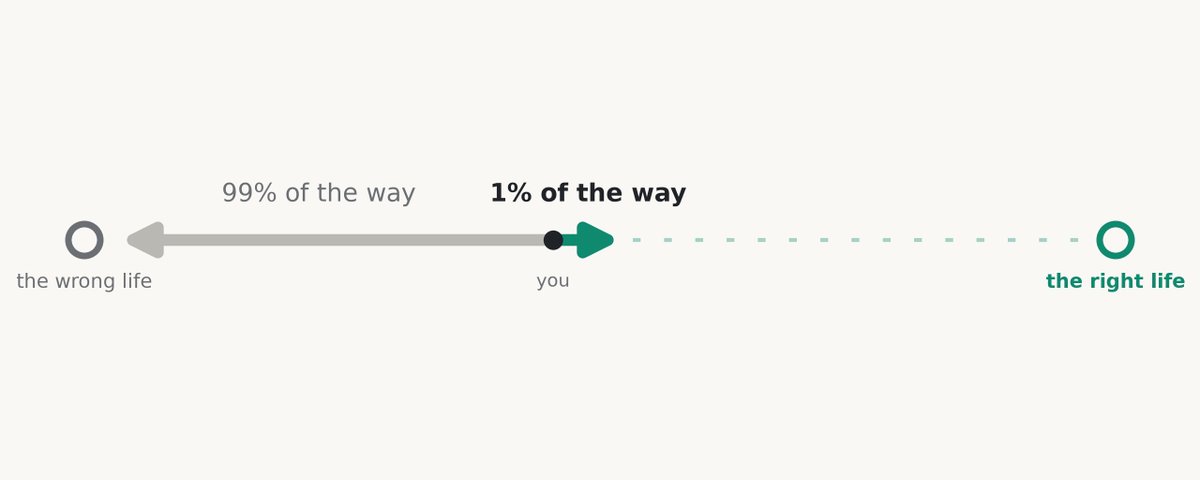
Being 1% of the way towards the right life is better than being 99% of the way towards the wrong one.
The Hormozi Problem
This brings me to Alex Hormozi.
I am so sick of people in the business world repeating his advice as if it's some sort of success bible.
Pick a better market. Build a 'Grand Slam Offer'. Do enough volume. Keep grinding. Scale or Die.
Hormozi is also the best public example I know of what happens when you solve the easy half completely and never do the hard one. In his interview with Tony Robbins, he explains that helping gym owners once felt meaningful, but by the hundredth and thousandth testimonial the feeling had gone.
"I do this because I don't know what else to do," he says. Then: "I do what I've been rewarded for doing."
The man who teaches how to be successful doesn't sound very successful.
Which raises the question of what success is. I think the definition is: are you enjoying your life? Money, revenue, headcount and status are inputs. They matter because of the life they produce. A company getting better while your life gets worse is not success. By that definition, Hormozi is winning a game and, in his own words, has lost the thing the game was for.
It would be convenient to claim that rich people are all miserable and money does not buy happiness. Newer research found that happiness keeps rising with income for most people, and rises fastest for the people who are already happiest. The only group it flattens for is the least happy. Money helps most when you already like your life.
Robbins put it well in the same interview: achievement is a science and fulfilment is an art. Hormozi has mastered the science. Most high-achieving people have by graduation. You can become so good at doing what the world rewards that you stop noticing whether you want the reward.
My Version
When I finished engineering, I had two paths in front of me.
One was a VC-backed AI startup: raise money, hire quickly, aim at a huge market and spend years trying to build a billion-dollar company. The other was Hourglass, a small bootstrapped services business with no prestige and no guarantee I could replace my salary.
By every metric the first option was the right choice, except for what I wanted. I had left my job because I hated being told what to do, and venture money would have given me a new set of bosses. I wanted control of my days, lots of different problems, and the ability to change direction without asking anyone.
For the first year, money mattered because I did not have enough of it. I made $700 in my first month. My savings eventually ran out. This year, Hourglass had its first six-figure month, and I noticed I was not worried about money anymore. My original goal was a lifestyle business, financial freedom and doing what I wanted. By my own definition, I had won the game.
Within a few weeks my brain offered me a new one. If we can do $100k, why not $200k? Why not the biggest AI agency in Australia? This felt like ambition.
That's why we keep arguing about Hourglass's shape while it grows. The obvious path is more salespeople with more delivery headcount behind them. The company I want is a small team with a lot of AI behind it, doing work we find interesting and turning it into products, with room to travel.
The Harder Question
Every business playbook is about the same thing: how to win. Pick the market, build the offer, do the volume. Hormozi's are some of the best written.
None of them can tell you what to want, and not because the authors are hiding it. What to want can't be sold. There is no market, no offer and no volume for it, so the internet will only ever hand you the easy half of the problem. That's why the advice gets repeated like scripture: it's the only half anyone can package.
The hard half you have to do yourself, and you have to do it before you pick the market and build the offer. Life will constantly push you towards growing metrics that look good on paper, but don't make you any more fulfilled.
Life is a series of choices, and I find every hard choice can actually narrowed down to what you should do vs. what you want to do. At every stage, you have to course correct for what excites you. As you get further down this path, the choices become harder and harder. Quitting your job, ending a friendship, moving cities. The challenge is giving up the good in search of the great.
Finding What You Want
There is no clear playbook for finding what you want, but here's what I've found works:
- Write the ordinary week. Not the exit, not the launch, not the promotion drinks. A Tuesday, if this works: where you wake up, who you answer to, what fills the calendar, what you're doing at 3pm. If you can't picture it, you don't want it yet. You want the idea of it.
- Write down enough. A number for money, one for headcount, one for status. Do it now while it's cheap, because when you hit it your brain will offer a bigger one within weeks, and it will feel like ambition.
- Take the audience away. If nobody could ever see the result, would you still want it? Most inherited goals fail this one.
- Take the win away. If you knew you would never get there, would you still choose the work? You will spend ten years in the process and ten minutes at the destination, so the process has to be worth it on its own. And notice which part of your life you're postponing until you make it. That's the price you're already paying.
- Check who rewarded you. Are you choosing this because you want it, or because you have been rewarded for it? Everything you're good at was rewarded by someone. Ask whether the reward was ever yours.
- Rerun it at every milestone. What you wanted at 21 with no money is not what you want at 25 with enough. Reread your answers when you hit a number, raise money, hire, or exit. If you don't, the default chooses for you.
I write about building an AI-native company every Friday: finlayekins.com/x