
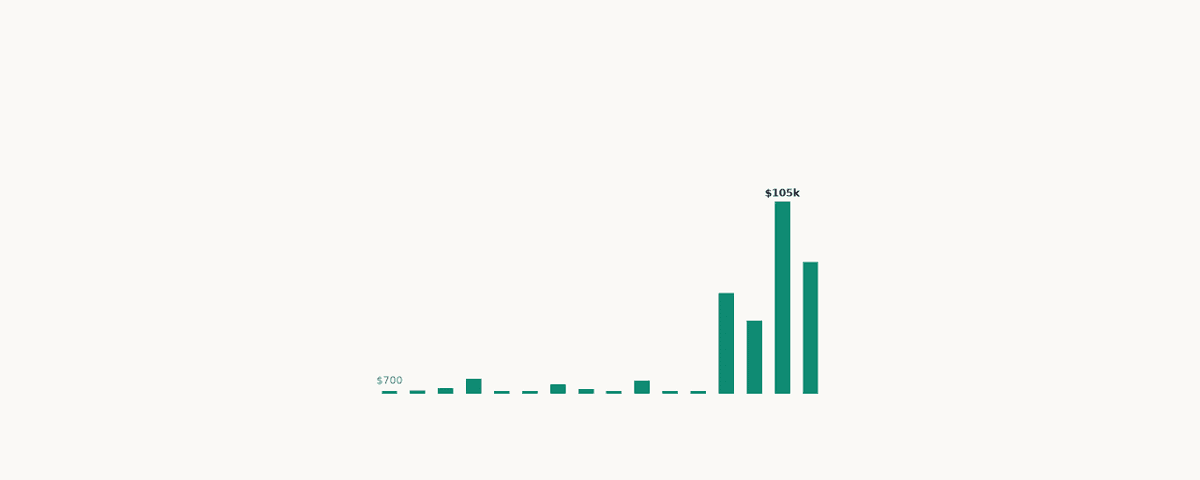
In May 2025, I quit my job to start a business, it only really took off a year later. The first month I made $700, in July, $105k.
Here's everything I learnt building Hourglass, looking backwards.
Quitting Was the Smallest Risk I Took
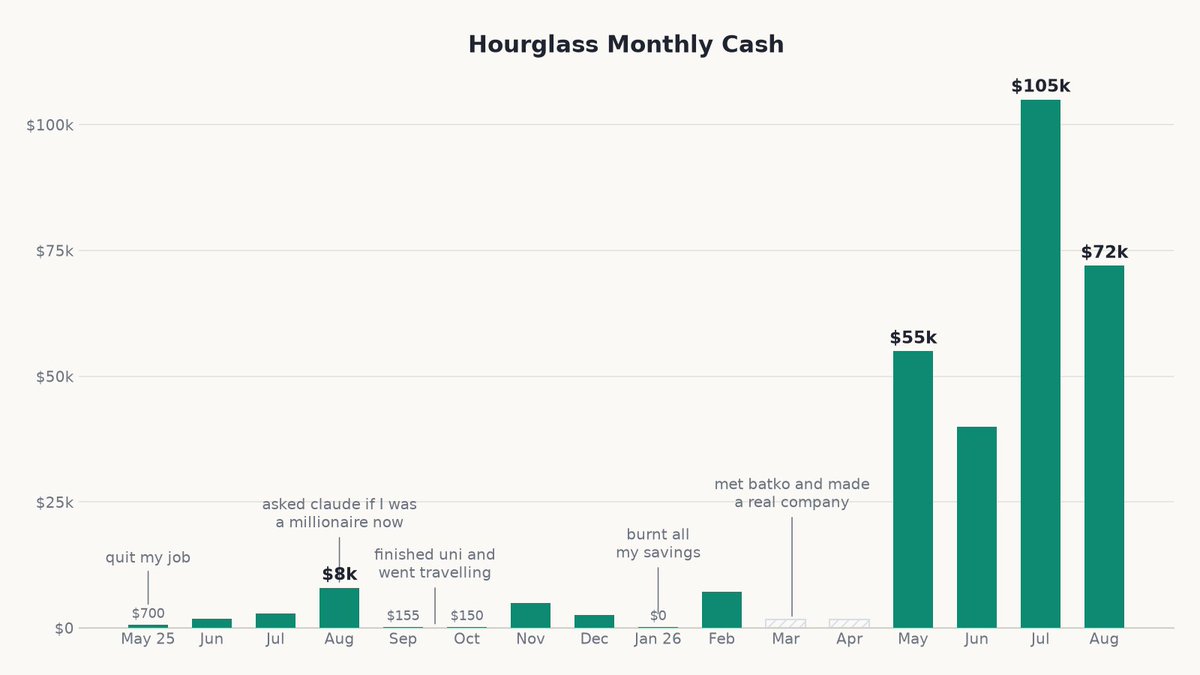
I quit my engineering job in May last year and made $700 in my first month: a $500 deposit on a scraping tool, split with a mate, and $200 for helping a psychologist set up Heidi Health. I decided that was the right time to go all in.
Everyone treats quitting as the big leap. Looking back, it was the smallest risk in this whole journey. The downside was staying exactly where I already was: worst case, I get another engineering job in a year, same desk, same salary, minus some savings. The upside had no ceiling. I've never understood why that trade is framed as brave.
That being said, the decision to quit was still the hardest one, and what stops most people. You have to give up your ego, your stability, and your career. The two things that pushed me on was this idea of a low downside, high upside risk, and the thought of being 80, and not living the life I wanted because it required a few months of uncertainty.
Another piece of fuel underneath it: I had a burning hatred of being told what to do. Being an employee, with no personal leverage, working on someone else's thing. I'd rather make $50k a year for the rest of my life running my own business than earn more in a job. I still think that, and knowing it about myself made every hard month afterwards survivable.
The Richest Man on Earth
The first time a client signed a real contract, I was the happiest I have ever been. When August hit $8,000, I wrote "91.2k ARR!" in my revenue tracker and walked around like the richest man on Earth. I'd annualised one good month and promoted myself to founder of a real company.
Both of those highs lasted about a week. Then I was just back to normal, working the same days, worrying about the next invoice.
That's the second lesson I could only see in reverse: we return to baseline fast. If you're chasing the feeling of the win, it's gone before the money clears. The thing that actually sustains you is wanting the work and the freedom itself, because that's what you're left with on the Tuesday after the win.
Also, annualising your best month is a fantasy. The chart makes that very clear.
The Business Stopped When I Did
I finished uni and went travelling for two months. September I made $155, October $150.
I knew, in theory, that a one-person business has no leverage. Watching my "91.2k ARR" company earn $305 across a quarter because I was on a beach taught it to me properly. There was no system, no team, no pipeline. There was just me, and I'd left.
I don't regret the trip and I came back happier than ever. But I learnt that until there's a machine that runs without you, you don't own a business. You own a job with no boss and no sick leave.
The Grim Months
November to February was really fkn hard. I restarted from zero, worked full-time every week, and the bank account didn't move. January was $0, exactly. My tracker note says "everyone was away" (i.e. no one wanted to pay me haha). My savings bottomed out pretty soon after that.
The hardest part wasn't any single failure. It was working a full month, at full effort, and making nothing, then getting up and doing it again with no evidence the next month would be different. My mates were earning salaries. I was cold-emailing people who didn't reply for six weeks, discovering how grim a real sales cycle is: businesses move slowly, decisions stall, "yes" in a meeting means an invoice two months later, if ever.
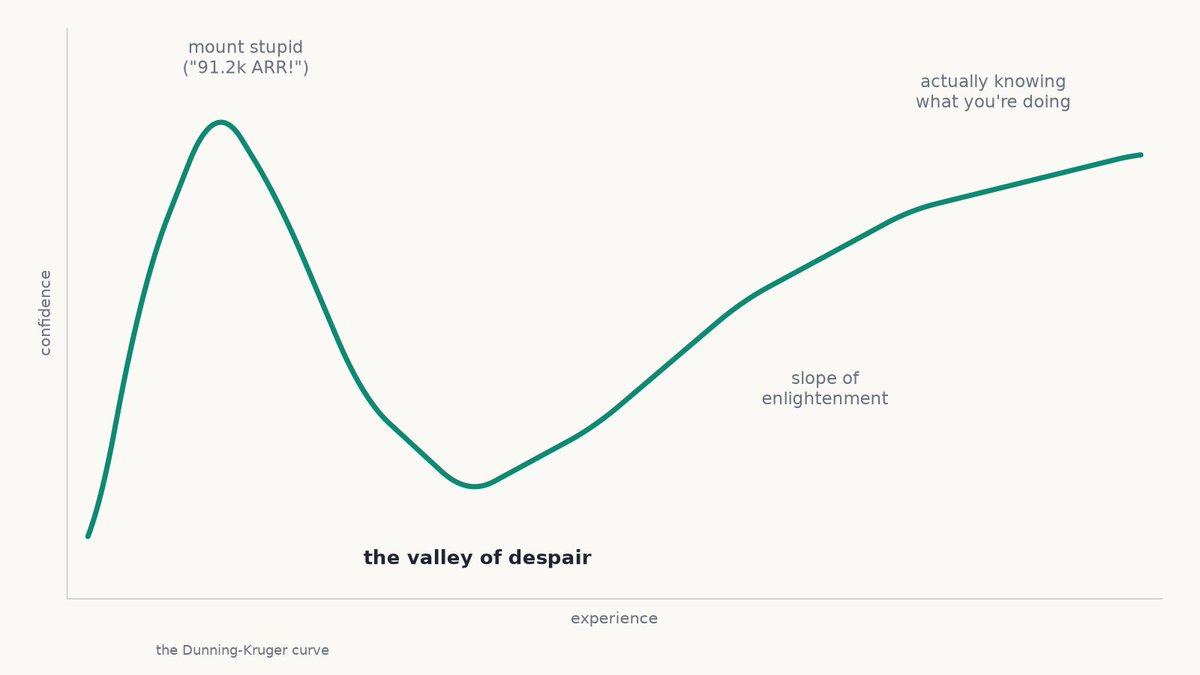
Here's the reframe I can see now: the valley of despair is a feature not a bug. The reason everyone can't run a business is that it's this hard, and the difficulty is the moat. You have to spend the months failing and figuring it out; that's the entry fee, and there's no way to pay it faster than the market lets you. If you walk in expecting the grim months, treating them as the course rather than a sign it isn't working, you're right, and you keep going. For most people, not factoring in how hard this part is going to be, is what makes them quit.
What kept me going was a kind of stubborn faith that full-time effort compounds even when the numbers say it isn't. It turned out to be true, but not in the way I expected. The compounding wasn't in the revenue. It was in me: every failed pitch and dead project was quietly teaching me the one thing I'd eventually be paid properly for. The next month I closed a $170k deal, over 5 times the revenue I made in the entire year prior.
The Right People Change Everything
In March I teamed up with Batko. He'd run Startmate and spent a decade around startups. I could build things with AI; he could sell, and knew everyone. We made a real company, Hourglass AI, and brought on two more young builders.
Working with the right people entirely changed what 'the thing' was, and the only reason I could form that team was because I had failed over and over for the past year.
The other important people are the ones supporting you. My parents constantly encouraged me when things were shit, and I felt I owed it to them and the easy life they'd given me, to have a real crack at what I wanted to do.
What All the Failing Bought
Eventually the same skills I'd been failing to sell for ten months started selling. May: $55k. June: $40k. July: $105k. August: $72k. Fully bootstrapped.
We also found the right system: paid audits that convert 80-90% into builds, monthly retainers instead of lumpy projects, referrals doing the selling, our own AI running our admin and even pricing our deals.
But the system only worked because of what the failing had already bought me: an actual understanding of what helps a business with AI, not in theory but in the specific, unglamorous ways companies really operate. Ten months of building the wrong things for anyone who'd pay taught me exactly where AI creates value inside a normal business and where it's a toy. There was no shortcut to these learnings, and that's kind of the whole point of this story.
The Lessons, In Reverse
Everything above, in the order I couldn't see it at the time:
- Quitting is the small risk. The downside is where you already are.
- Know why you're really doing it. Mine was leverage and hating being told what to do. That reason survives bad months; "getting rich" doesn't.
- The peaks return to baseline in days. Build for the Tuesday after the win.
- A solo business stops when you stop. No system, no business.
- The grim months are the course fee, and the difficulty is the moat. Expect them and you'll keep going.
- Sales cycles are slower than your bank balance wants them to be.
- Effort compounds, but at least 2 months before it shows in the revenue.
- The right people change what the business is. Find your combo before your niche.
- All the failing is buying the thing you'll eventually be paid for.
- You don't need to burn out. I worked 9 to 5 through nearly all of this.
Start the thing.
I write about AI & building this company every Friday, real numbers included → finlayekins.com/x